


On Tuesday, November 3, more than a hundred million Americans took to the polls and delivered a sweeping rebuke of President Trump and the Republican party. The Democrats won a majority in the House of Representatives as well as the Senate, allowing them to have greater control over legislation as well as the ability to restrict President Trump’s agenda.
According to media reports, voters were concerned with the rising price of gas and other everyday necessities, the war in Iran, and in some cases, President Trump’s overall style of governing.
The midterms are a crucial part of the American democratic system. Every four years, halfway between presidential elections, Americans can vote on matters such as who will represent them in Congress and local referendums. The midterm elections play a significant role in determining the president’s power for the second half of their term, since Congress has the ability to either put checks on or help carry out the president’s agenda.
These elections are “often looked to as a commentary on how people think the party in power is doing,” said history teacher Jeffrey Welch. “There’s an opportunity for control over one or both houses of Congress to go from one party to the other.” And indeed it did. According to results available November 17, the Democrats flipped nine seats in the Senate. Some of these victories were surprising, such as in Kansas, where a Democratic senator had not been elected since 1932, and in Texas, where James Talarico became the first Democratic senator elected since 1994. Flipping such states blue is an “extraordinary feat,” Welch said. These historic wins along with other flipped seats gave the Democratic Party a clear majority in the Senate. In the House, the Democrats turned a large number of districts and are on track to have 50 seats more than Republicans. On top of that, the Democrats flipped five gubernatorial races and now make up the majority of state governors.
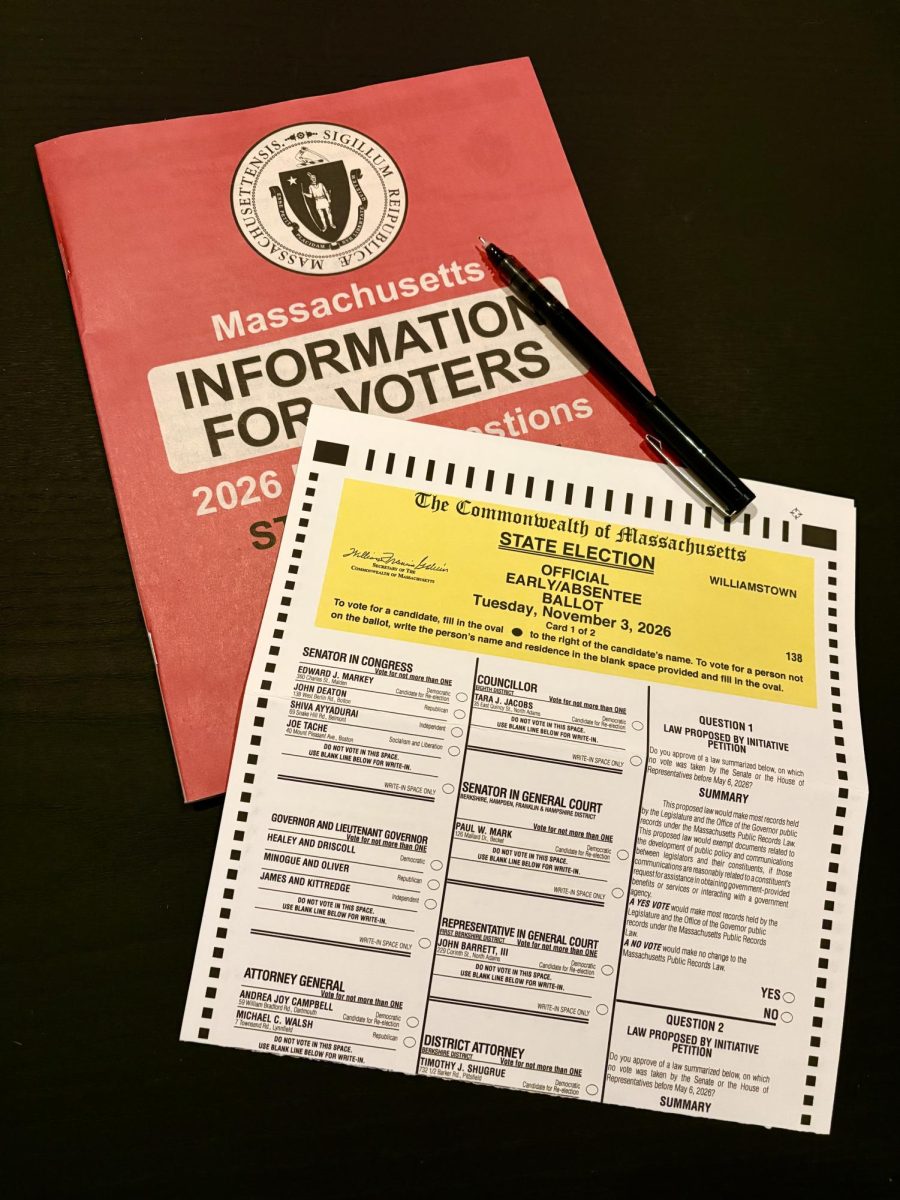
In Massachusetts, voters decided on a race for governor, a few spots in Congress, and a lot of referendums. In fact, Massachusetts voters have never seen more ballot questions than they did this year. In the gubernatorial race, incumbent Maura Healey, a Democrat, was reelected over the Republican candidate, Mike Minogue. For the Senate, Democrat Edward Markey successfully ran for reelection against Republican candidate John Deaton. In Massachusetts District 1, which includes the Berkshires and Springfield, Democrat Richard Neal was reelected to the House of Representatives over independent candidate Nadia Milleron.
The Massachusetts electorate voted on nine ballot questions. Questions 8 and 9 have been the main focus of public discussion. Question 8 asked whether recreational cannabis should remain legal, and the vast majority voted affirmatively. The topic of Question 9 was whether to keep a law that increases the regulation of firearms, and the vote resulted in a yes, meaning the law will stay in place.
Meanwhile in Washington, the divided government may prove to be a source of tension and make it difficult to pass legislation. “There has to be a relationship between Congress and the presidency in order for laws to be enacted,” Welch said.